Why Retrieval Practice Helps Students Learn Mathematics
Retrieval practice enhances mathematical learning by strengthening memory through active recall rather than passive review. This strategy promotes long-term retention, narrows achievement gaps between students of varying prior knowledge, and facilitates the transfer of mathematical concepts to new contexts.
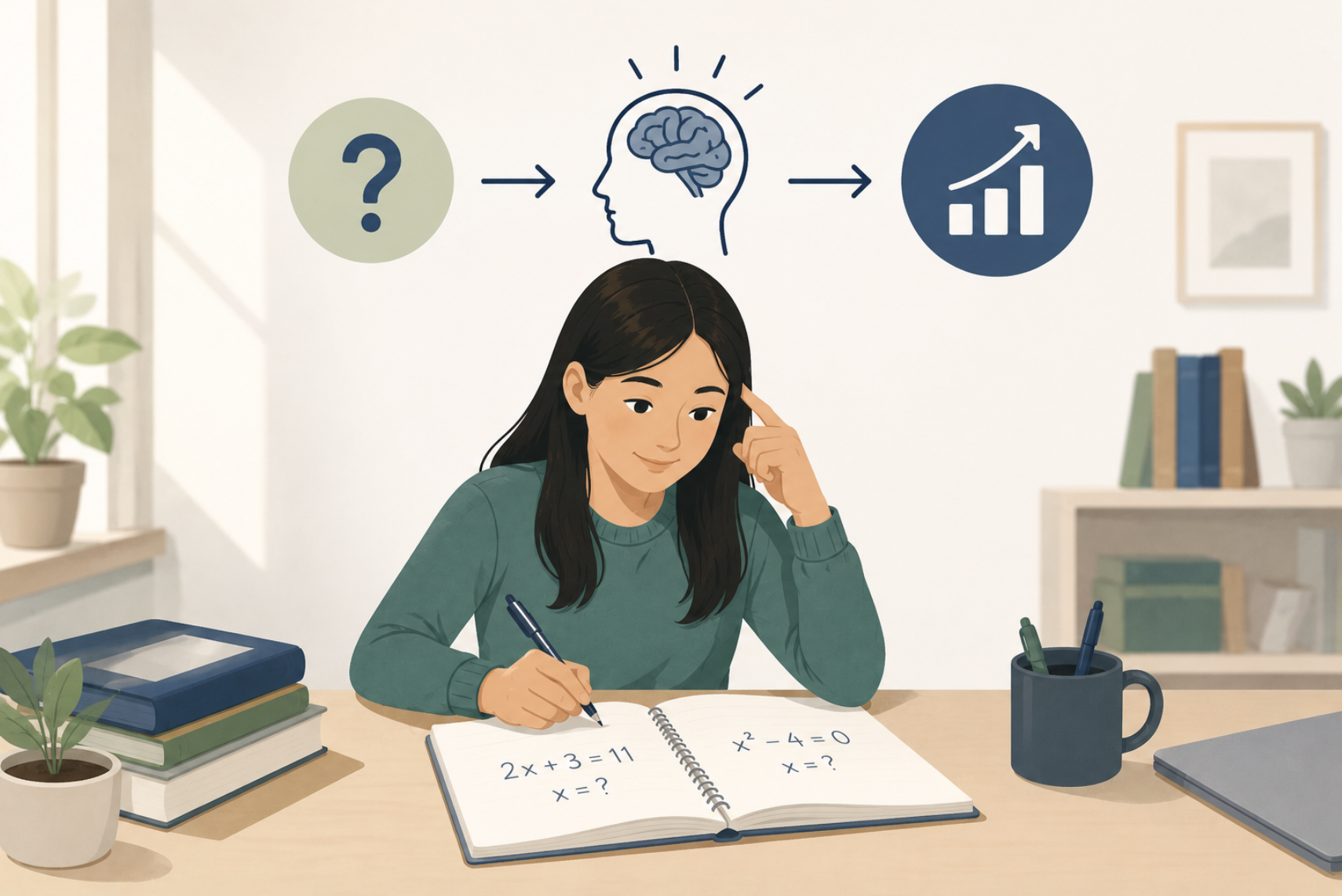
Cognitive and neurological mechanisms
Retrieval practice functions as a strategic tool to enhance memory by compelling the brain to actively recover information, a process that significantly strengthens neural pathways compared to passive restudy (Lyle et al., 2020; Muzsnay et al., 2025). Neurologically, the act of retrieving information from memory increases the likelihood that the specific content will be retained for future use (Lyle et al., 2020). This mechanism is often described as "test-enhanced learning," where the effortful process of recall acts as a catalyst for deeper cognitive processing (Koh et al., 2018).
Research indicates that retrieval practice can be linked to the "learning-by-teaching" phenomenon (Duran, 2017); when individuals teach without relying on notes, they are effectively engaging in retrieval, which produces learning benefits comparable to dedicated retrieval practice. By forcing the learner to reconstruct knowledge rather than simply reviewing it, the brain engages in a more robust encoding process (van Kesteren & Meeter, 2020). Furthermore, the strategic use of interleaving—alternating between different types of mathematical problems—promotes deeper cognitive processing and reduces mental overload, aligning with cognitive load theory to facilitate better knowledge transfer (Richland et al., 2017).
References
Duran, D. (2017). Learning-by-teaching. Evidence and implications as a pedagogical mechanism. Innovations in education and teaching international, 54(5), 476-484.
Lyle, K. B., Bego, C. R., Hopkins, R. F., Hieb, J. L., & Ralston, P. A. (2020). How the Amount and Spacing of Retrieval Practice Affect the Short- and Long-Term Retention of Mathematics Knowledge. Educational Psychology Review, 32(1), 277–295. https://doi.org/10.1007/S10648-019-09489-X
Koh, A. W. L., Lee, S. C., & Lim, S. W. H. (2018). The learning benefits of teaching: A retrieval practice hypothesis. Applied Cognitive Psychology, 32(3), 401-410.
Muzsnay, A., Szabó, C., Zámbó, C., Szabó, G., & Szeibert, J. (2025). Retrieval Practice—A Tool to Narrow the Achievement Gap in Learning Higher Mathematics. International Journal of Science and Mathematics Education. https://doi.org/10.1007/s10763-025-10607-1
Richland, L. E., Begolli, K. N., Simms, N., Frausel, R. R., & Lyons, E. A. (2017). Supporting mathematical discussions: The roles of comparison and cognitive load. Educational Psychology Review, 29(1), 41-53.
van Kesteren, M. T. R., & Meeter, M. (2020). How to optimize knowledge construction in the brain. npj Science of Learning, 5(1), 5