Conceptual vs. Procedural Knowledge: Do Students Need Both?
Students can often follow the steps of a statistical procedure and arrive at the correct answer. But do they understand why the procedure works, what the result means, or when it should be used?
This distinction lies at the heart of procedural and conceptual knowledge.
Knowing How and Knowing Why
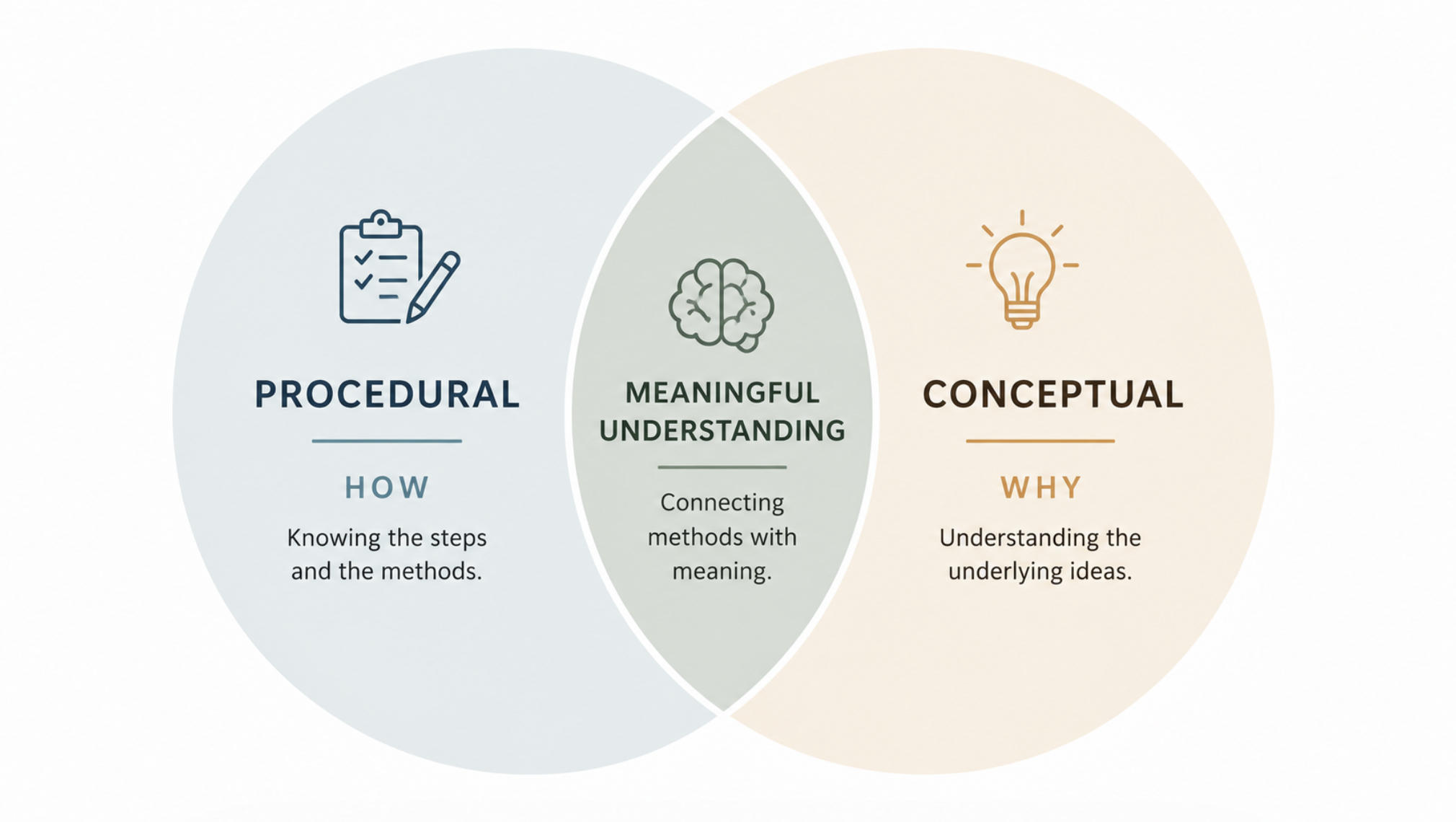
Procedural knowledge is about knowing how.
In statistics, this means knowing how to select and apply procedures or techniques to solve a statistical problem. A student might know how to calculate a mean, create a graph, find a standard deviation, or follow the steps of a statistical analysis.
Conceptual knowledge is about knowing why.
It involves understanding the meaning behind statistical ideas, recognizing connections among concepts, and explaining statistical information within a real-world context.
Consider a simple example:
A student may know how to calculate the mean correctly:
Procedural → Add the values and divide by the number of observations.
But conceptual understanding goes further:
Conceptual → What does the mean tell us about this particular group of data? How might an extreme value affect it? Would the mean still be the best way to describe what is “typical”?
The first requires knowing a procedure. The second requires understanding what that proceduremeans.
We Need Both
Procedural and conceptual knowledge should not be viewed as competing approaches to learning. Both are important for developing meaningful mathematical and statistical understanding (Hiebert & Lefevre, 1986; Lenz et al., 2020).
Research also suggests that procedural and conceptual knowledge can develop through an iterative, bidirectional relationship. Growth in conceptual knowledge can support the development of procedural knowledge, while experiences with procedures can, in turn, contribute to deeper conceptual understanding (Rittle-Johnson & Schneider, 2015).
“Knowing how can strengthen knowing why—and knowing why can make knowing how more meaningful.”
This relationship is particularly important in statistics. Learning statistics involves more than performing calculations. Students must also interpret statistical information, recognize relationships among concepts, reason within context, and understand what their results actually mean. Research in statistics education, however, has not always defined procedural and conceptual knowledge in the same way. Studies have differed in how they characterize procedural knowledge and whether conceptual knowledge should be understood as implicit, explicit, or both (Alacaci, 2004; Christiansen, 2019; Kim et al., 2009; Lenz et al., 2020; Lipson, 2003).
In my dissertation research (Liew, 2025), I approached the distinction through two simple but interconnected ideas:
Procedural knowledge: knowing how
Knowing how to appropriately apply statistical procedures or techniques in different situations.
Conceptual knowledge: knowing why
Understanding the meaning behind statistical ideas, recognizing connections among concepts, and explaining those ideas within real-world contexts.
A student who can perform a calculation correctly may therefore still have an incomplete understanding of the statistical concept behind it.

From Research → Practice
So, what does this mean for instruction?
If we want students to develop meaningful statistical understanding,getting the correct answer cannot always be the end of the learning process.
After students complete a procedure, we can extend their thinking with questions such as:
How did you get your answer? — reveals procedural thinking.
Why does this method make sense here? — probes conceptual understanding.
What does your answer mean in this context? — connects the statistical result to the real situation.
What would happen if the data changed? — examines whether understanding extends beyond a memorized procedure.
Can you explain this result without relying only on the formula? — encourages students to articulate the underlying statistical idea.
Even a small shift in the questions we ask can reveal an important distinction:
“Can a student produce an answer — or can the student make sense of the answer?”
Effective statistics instruction should help students do both.
Key Takeaway:
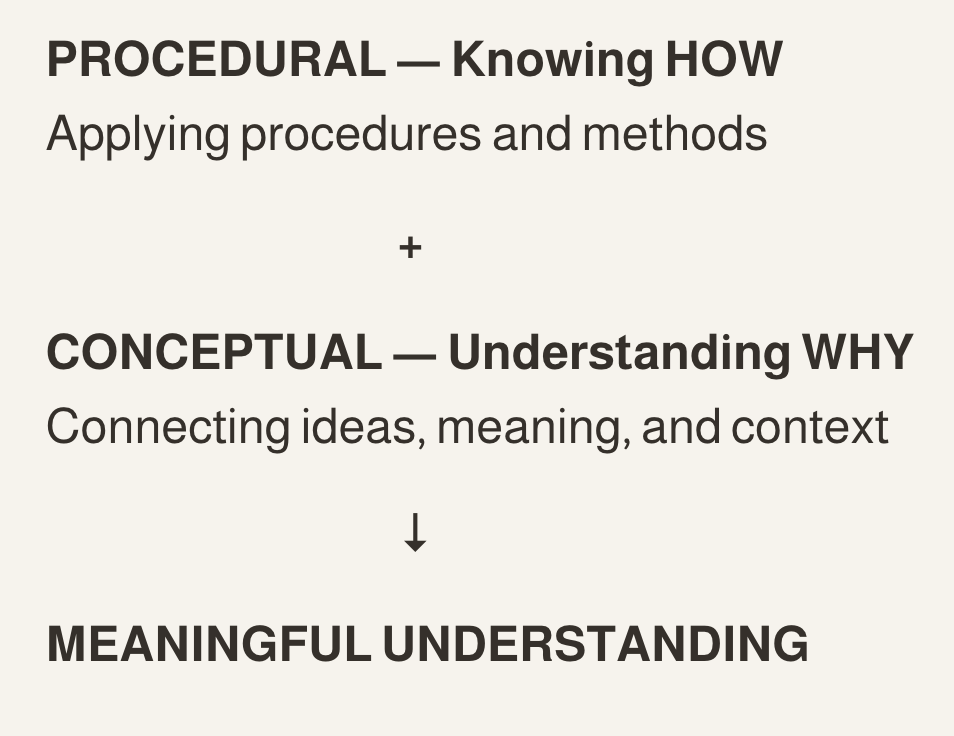
Procedural fluency matters. Conceptual understanding matters. The goal is not to choose one over the other, but to design learning experiences that help students connect what they are doing with why it makes sense.
References
Alacaci, C. (2004). Inferential statistics: Understanding expert knowledge and its implications for statistics education. Journal of Statistics Education, 12(2). https://doi.org/10.1080/10691898.2004.11910737
Christiansen, M. H. (2019). Implicit statistical learning: A tale of two literatures. Topics in Cognitive Science, 11(3), 468-481.
Hiebert, J., & Lefevre, P. (1986). Conceptual and procedural knowledge in mathematics: An introductory analysis. In J. Hiebert (Ed.), Conceptual and procedural knowledge: The case of mathematics (pp. 1–27). Lawrence Erlbaum Associates.
Kim, R., Seitz, A., Feenstra, H., & Shams, L. (2009). Testing assumptions of statistical learning: is it long-term and implicit?. Neuroscience Letters, 461(2), 145-149. https://doi.org/10.1016/j.neulet.2009.06.030
Lenz, K., & Wittmann, G. (2020). Individual differences in conceptual and procedural fraction knowledge: What makes the difference and what does it look like?. International Electronic Journal of Mathematics Education, 16(1), em0615. https://doi.org/10.29333/iejme/9282
Liew, J. S. (2025). A Mixed Methods Study: Procedural and Conceptual Knowledge in Basic Statistics for University Students. Southern Illinois University at Carbondale.
Lipson, K. (2003). The role of the sampling distribution in understanding statistical inference. Mathematics Education Research Journal, 15(3), 270-287. https://doi.org/10.1007/BF03217383
Rittle-Johnson, B., & Schneider, M. (2015). ‘Developing conceptual and procedural knowledge of mathematics’, in Roi Cohen Kadosh, and Ann Dowker (eds), The Oxford Handbook of Numerical Cognition (pp. 1102-1118). Oxford, UK: Oxford University Press.https://doi.org/10.1093/oxfordhb/9780199642342.013.014